
Complete Guide to Concrete Slabs in College Park, GA
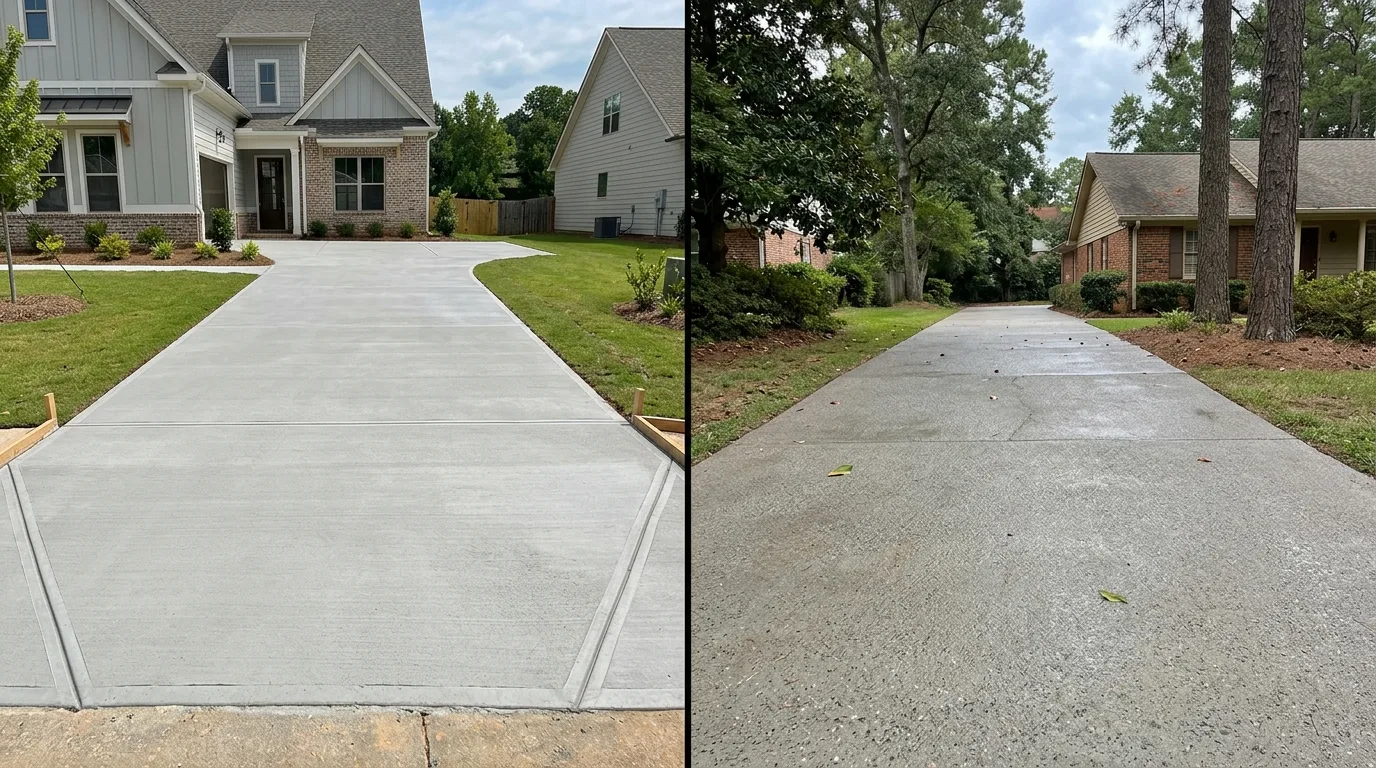
Whether you’re adding a garage, building a workshop, or creating a foundation for an accessory structure, a concrete slab is typically where the project starts. In College Park, Georgia, concrete slab installation has specific requirements driven by Fulton County’s expansive red clay soil — requirements that affect everything from how deep you excavate to what thickness and reinforcement you specify. In this guide, we cover everything College Park homeowners and business owners need to know about concrete slab installation, from specification through permit to pour.
Planning a Concrete Slab in College Park?
We provide free estimates with full specification. Call College Park Concrete at (888) 376-0955.
Why Concrete Slabs Require More Preparation in College Park
A concrete slab that’s poured directly on Georgia red clay without an isolating base layer is essentially a rigid structure sitting on a material that swells up to 30% when wet and contracts when dry. The math is straightforward: if the soil beneath the slab rises 1 inch during College Park’s wet season, the slab either rises with it or cracks. Most residential slabs in the City Center area and Helmwood neighborhood are too large to rise uniformly — they crack.
The solution — which is standard practice for every slab we install in College Park — is a 4–6-inch compacted aggregate base that doesn’t expand with moisture. This layer separates the rigid concrete from the reactive clay, provides drainage for water that reaches the sub-base level, and creates a uniform bearing surface that the concrete can be poured on confidently. It adds cost (and time) to the project, but it’s the difference between a slab that lasts 30–50 years and one that needs major repair within a decade.
Types of Concrete Slabs in College Park
Garage slabs are the most common residential slab application in College Park. Standard residential garage slabs are poured at 4 inches thickness for standard passenger vehicles. Garages that will see truck storage, heavy equipment, or RVs benefit from 5–6 inches. Rebar reinforcement on a 24-inch grid is standard for garage slabs — fiber mesh is an alternative for lighter applications. Thickened perimeter edges (8–12 inches at the edges tapering to 4 inches in the field) provide additional support along the foundation perimeter.
Addition foundations require slabs that integrate with the existing home’s foundation system. The slab must be reinforced to carry the structural load of the walls above it, which means consulting with the home’s structural design. College Park Building & Inspections will require engineering documentation for structural addition foundations in most cases.
Accessory structure slabs — for detached garages, storage buildings, workshops, and similar uses — range from simple utility slabs (4 inches, fiber mesh, minimal reinforcement) to fully engineered slabs that match the complexity of the main house foundation.
Utility and patio slabs at the simple end of the spectrum — concrete pads for AC units, water heaters, generators, hot tubs — are typically 4 inches with fiber mesh or light rebar reinforcement. These smaller slabs are less likely to require permits but benefit from the same base preparation principles.
Commercial interior floors for warehouse, retail, and industrial applications are specified for the specific equipment and loads they’ll carry. A concrete floor for light office use (4 inches, light reinforcement) is completely different from a forklift floor in a logistics warehouse (6 inches minimum, fiber reinforcement, hardener or densifier, saw-cut joint pattern).
Slab Specifications for College Park’s Conditions
The minimum specification we use for residential slabs in College Park on red clay soil:
- Excavation: 6–8 inches below finished grade
- Base: 4–6 inches compacted crush-and-run (compacted to 95% proctor density)
- Concrete thickness: 4 inches for standard residential; 5–6 inches for heavy vehicle storage
- Concrete mix: 3,500 PSI minimum for residential; 4,000 PSI for garage floors and heavier applications
- Reinforcement: #4 rebar on 24-inch centers for garage slabs; fiber mesh as alternative for patios and utility slabs
- Control joints: Saw-cut at 10–12 feet on center (or slab thickness in feet × 2.5, whichever is less)
- Sealer: Penetrating silane-siloxane sealer applied after 28-day cure
These specifications are not the cheapest way to pour a slab in College Park — they’re the way that produces a slab that performs as expected over decades on Fulton County’s red clay.
Get a Properly Specified Concrete Slab in College Park
We itemize every spec in our estimate — no vague 'standard slab' quoting. Call (888) 376-0955.
Practical Uses for Concrete Slabs in College Park
- New garage construction: The most common residential slab project. A standard two-car garage slab (600–800 sq ft) costs $2,400–$6,400 depending on thickness and reinforcement spec. Permits required.
- Carport to garage conversion: Converting a covered carport to enclosed garage space requires a properly reinforced slab capable of supporting the new walls and roof. The existing carport slab (if it exists) is often inadequate for this purpose.
- ADU or in-law suite slab: Accessory dwelling units are increasingly common in College Park’s residential areas. ADU slabs require structural design coordination and Fulton County permit review.
- Workshop floor: A properly finished concrete workshop floor — smooth steel-trowel finish with sealed surface — creates a practical workspace that handles tool storage, vehicle maintenance, and woodworking without the dust and drainage problems of bare earth or gravel floors.
- Outdoor storage pad: A concrete pad for outdoor equipment storage, trash enclosures, or generator placement is a small slab application ($500–$1,200 for a 100–150 sq ft pad) that creates a clean, permanent surface.
- Commercial floor replacement: College Park businesses near the airport corridor often need interior floor replacement for warehouse and industrial spaces that have deteriorated beyond practical repair. These commercial floor projects involve the full specification range described above.
Permits for Concrete Slabs in College Park
Garage slabs, addition foundations, and structural slabs for accessory structures require building permits from College Park Building & Inspections at (404) 679-3118. The permit confirms that the slab is properly designed for its structural application, meets setback requirements, and is inspected to confirm it was built to the approved plans.
Non-structural utility slabs under a certain square footage may not require permits — College Park’s permit office can confirm the threshold for your specific situation. Georgia contractor licensing is required for all slab projects over $2,500. We include permit coordination in every project, and permit costs are included in our written estimates.
Frequently Asked Questions
How much does a concrete slab cost in College Park, GA?
Concrete slab installation in College Park runs $4–$8 per square foot for standard residential applications. A 400-square-foot single-car garage slab costs approximately $2,000–$4,000. A 700-square-foot two-car garage slab runs $3,500–$7,000 depending on thickness and reinforcement. These prices include excavation, base preparation, concrete, finishing, and joint cutting. See our concrete slab installation page for more detailed pricing by application.
What thickness should a concrete garage slab be in College Park?
Four inches is the standard residential garage slab thickness for standard passenger vehicles. If the garage will store trucks, SUVs on lifts, motorcycles on center stands, or any equipment over 6,000 pounds, 5–6 inches provides better load distribution and reduces the risk of cracking under point loads. On College Park’s red clay, the base preparation under the slab matters as much as the slab thickness — a 4-inch slab on a proper base outperforms a 6-inch slab on bare clay.
Do I need a permit for a concrete slab in College Park, GA?
Structural slabs (garages, additions, accessory structures) require a building permit from College Park Building & Inspections at (404) 679-3118. Small utility slabs may not require permits depending on size and use. Georgia requires contractor licensing for projects over $2,500. We handle permit coordination for every slab project and include permit costs in our written estimates. See our complete guide to concrete permits in College Park for more detail.
Concrete Slab Installation in College Park — Done Right
Proper base prep, right reinforcement, built for Georgia red clay. Call (888) 376-0955 for a free estimate.
Related: