
College Park Georgia Red Clay: Why Concrete Prep Is Critical
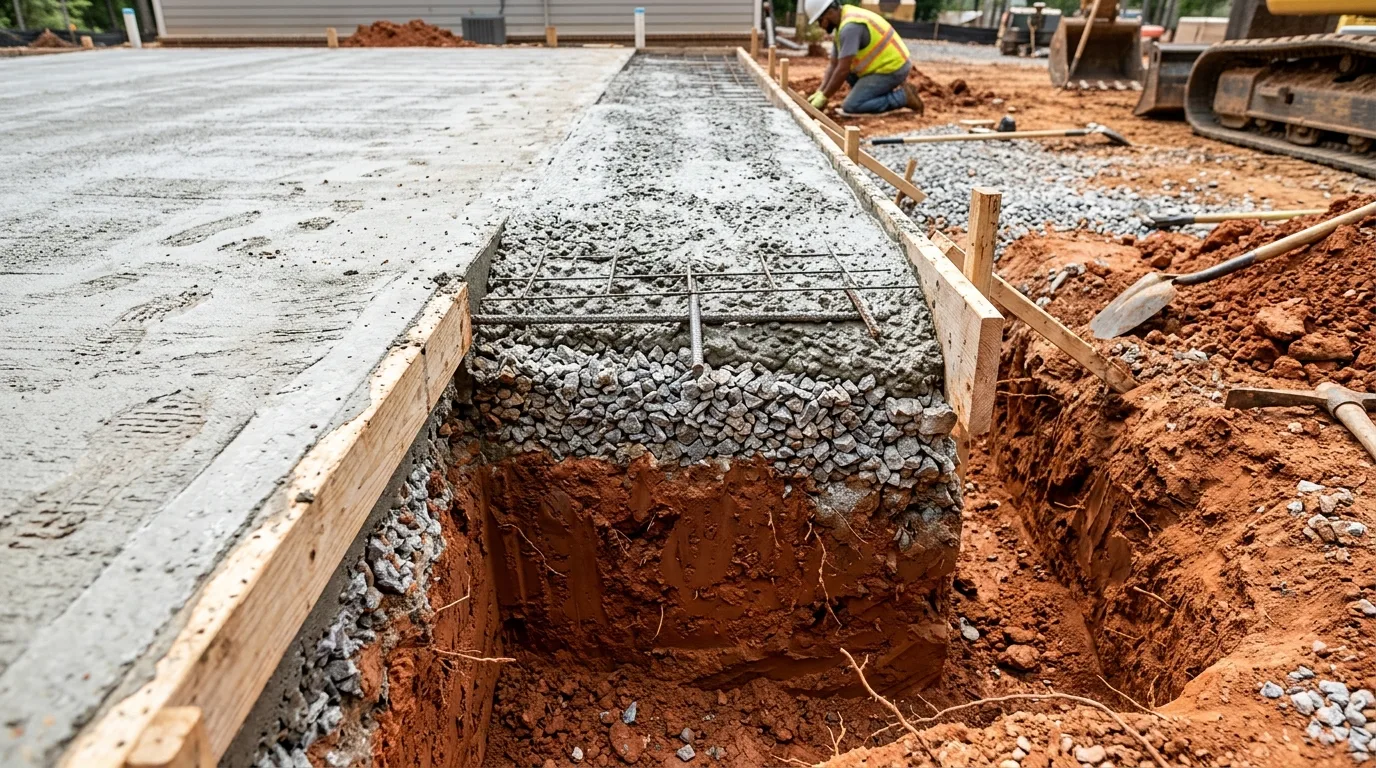
If you’ve lived in College Park long enough, you’ve probably watched a neighbor’s driveway or patio crack within a few years of being poured. The culprit is rarely the concrete itself — it’s what’s beneath it. Georgia red clay soil is the primary driver of concrete failure in Fulton County, and understanding how it works is the first step toward avoiding an expensive mistake. In this post, we cover why red clay creates such challenging conditions for concrete in College Park, what happens when contractors ignore it, and what proper preparation looks like.
Building on Georgia Red Clay in College Park?
We build concrete that accounts for soil movement — not just the surface. Call (888) 376-0955 for a free assessment.
Why Georgia Red Clay Matters for College Park Homeowners
Georgia red clay is what geologists call an expansive soil — specifically a kaolinite-rich ultisol that absorbs water and physically swells in volume. When College Park receives rainfall — and the area averages 52 inches per year — the clay beneath your driveway, patio, or foundation expands. When dry conditions return in winter or during droughts, that same clay contracts. The swing can be 10–30% in volume, applied directly to whatever is sitting on top.
For a concrete slab poured directly on red clay without any isolating aggregate base, this means the slab is being pushed from below during wet months and losing support from below during dry months — simultaneously experiencing compression and tension it wasn’t designed for. The result is predictable: cracking starts at the edges or control joints within a few years, progresses to the field of the slab, and eventually leads to differential settlement where one section is noticeably higher or lower than adjacent sections.
In the Helmwood neighborhood and along older residential streets near Woodward Academy, this pattern is visible on driveways installed 10–15 years ago without proper base preparation. The concrete itself is often perfectly fine — it’s the sub-base that failed.
Types of Concrete Problems Caused by Red Clay
Differential settlement occurs when one section of a slab sits on soil that has contracted more than adjacent sections. The result is a raised edge or “lip” at control joints that creates a trip hazard and routes water flow to unintended areas. In College Park, differential settlement is the most common foundation repair call we receive in the Eagan Park and City Center neighborhoods.
Upward heave is the opposite — sections of the slab pushed upward when saturated clay expands. This is most common at the perimeter of slabs where clay can access moisture more readily and where weight from the center of the slab doesn’t resist the upward pressure. Heave is often mistaken for poor installation, but it’s actually the soil responding to moisture exactly as its chemistry dictates.
Edge cracking starts at the perimeter of slabs because the edges have less structural support than the interior. Red clay movement concentrates stress at these unsupported edges, producing the characteristic cracking pattern that runs parallel to the slab edge within a foot or two of the perimeter.
Sub-base voids form when clay contracts during dry periods and pulls away from the bottom of the slab. These voids leave the slab spanning across empty space, and when load is applied to that section, the unsupported concrete cracks or deflects. Voids beneath slabs are the main reason mudjacking becomes necessary — a clay soil problem solved by pumping grout beneath the slab to restore bearing contact.
Practical Uses for Understanding Red Clay in Concrete Projects
- Driveway installation: Any new concrete driveway in College Park should specify a 4–6 inch compacted crush-and-run base with proper drainage grading. This is the most common application where base prep gets cut for cost and the most common application where homeowners pay for it in repairs.
- Patio slabs: Patios in the Historic College Park District and surrounding neighborhoods are susceptible to the same clay movement as driveways. A proper base extends patio life from 10–15 years to 25–40 years.
- Garage floors: Garage slabs without adequate base preparation are a common problem in older College Park homes. A settling garage floor can cause problems with the garage door, create drainage into the home, and eventually require full replacement.
- Foundation assessments: Diagonal cracks at door and window corners in College Park homes are almost always a clay soil story — the foundation is responding to differential soil movement. Understanding the soil helps prioritize drainage correction before structural repair.
- Sidewalk and walkway work: Short spans crack less dramatically than large slabs, but even sidewalks in College Park benefit from proper base prep. The added cost is minimal relative to the extended service life.
- Commercial flatwork: Near the Hartsfield-Jackson corridor, commercial parking lots and loading areas must account for red clay under heavy vehicle loads — where residential base prep specs are insufficient and commercial-grade specifications are required.
How Contractors Handle Red Clay in College Park
The correct approach involves three steps that work together: drainage, isolation, and reinforcement. Drainage means grading the site so water flows away from the slab perimeter rather than pooling against it and saturating the clay beneath. Isolation means installing 4–6 inches of compacted aggregate (crushed stone or gravel) that doesn’t expand with moisture — creating a stable platform between the clay and the concrete. Reinforcement means using #4 rebar on a 24-inch grid (or equivalent fiber mesh for smaller applications) that holds the slab together if soil movement does cause deflection.
A contractor who addresses all three provides a slab that can handle College Park’s soil conditions. One who addresses only one or two may produce acceptable short-term results but will see failures within a decade. When comparing estimates, ask specifically: what is the base depth and material, is drainage grading included, and what reinforcement is specified? The answers reveal whether the contractor actually understands what they’re building on.
Georgia Red Clay Requires Concrete Specialists
College Park Concrete builds proper bases before every pour. Call (888) 376-0955 for a free written estimate.
Cost Consequences of Ignoring Red Clay Prep
A homeowner who saves $500–$800 by accepting an estimate that skips proper base preparation typically faces one of two outcomes: cracks and settlement within 5–8 years requiring significant repair, or full replacement within 10–15 years. Either outcome costs more than the money saved at installation.
Concrete driveway replacement in College Park runs $3,000–$6,000 for a standard two-car driveway. Foundation repair for clay-related settlement ranges from a few thousand dollars for minor stabilization to $15,000+ for major pier installation and drainage correction. The upfront cost of proper base preparation — typically $1–$3 per square foot more than a bare-minimum installation — is almost always the better economic decision across the life of the project.
Frequently Asked Questions
How does Georgia red clay specifically affect concrete in College Park?
Georgia red clay expands when wet and contracts when dry — a physical process driven by its kaolinite content. This volumetric movement applies pressure to concrete slabs from below, causing cracking, settling, and heave depending on where in the moisture cycle the soil is at any given time. College Park’s 52-inch annual rainfall and hot, dry summer periods create ideal conditions for this movement to cause concrete damage over time.
What does proper base preparation for red clay cost in College Park?
Adding 4–6 inches of compacted crush-and-run aggregate base to a concrete driveway in College Park typically adds $1–$3 per square foot to the total project cost, or $500–$1,500 for a standard 500-square-foot driveway. This investment extends the expected service life from 10–15 years to 30–50 years on College Park’s expansive clay soil.
Can you fix a concrete slab that was poured without adequate base prep?
Partially. If the slab is still structurally sound but has settled or heaved, mudjacking can lift and re-level it by pumping grout beneath it. If drainage is corrected at the same time, mudjacking can add years to the slab’s life. However, if the original base was fundamentally inadequate and clay movement has caused widespread cracking, full replacement with proper base preparation is usually more cost-effective than repeated repairs. See our concrete repair services in College Park for help assessing your specific situation.
Build Concrete Right on College Park's Red Clay
Call (888) 376-0955 for a free site assessment. We specify the correct base for your soil conditions before any project begins.
Related: