
College Park Driveways: Concrete vs. Asphalt Compared
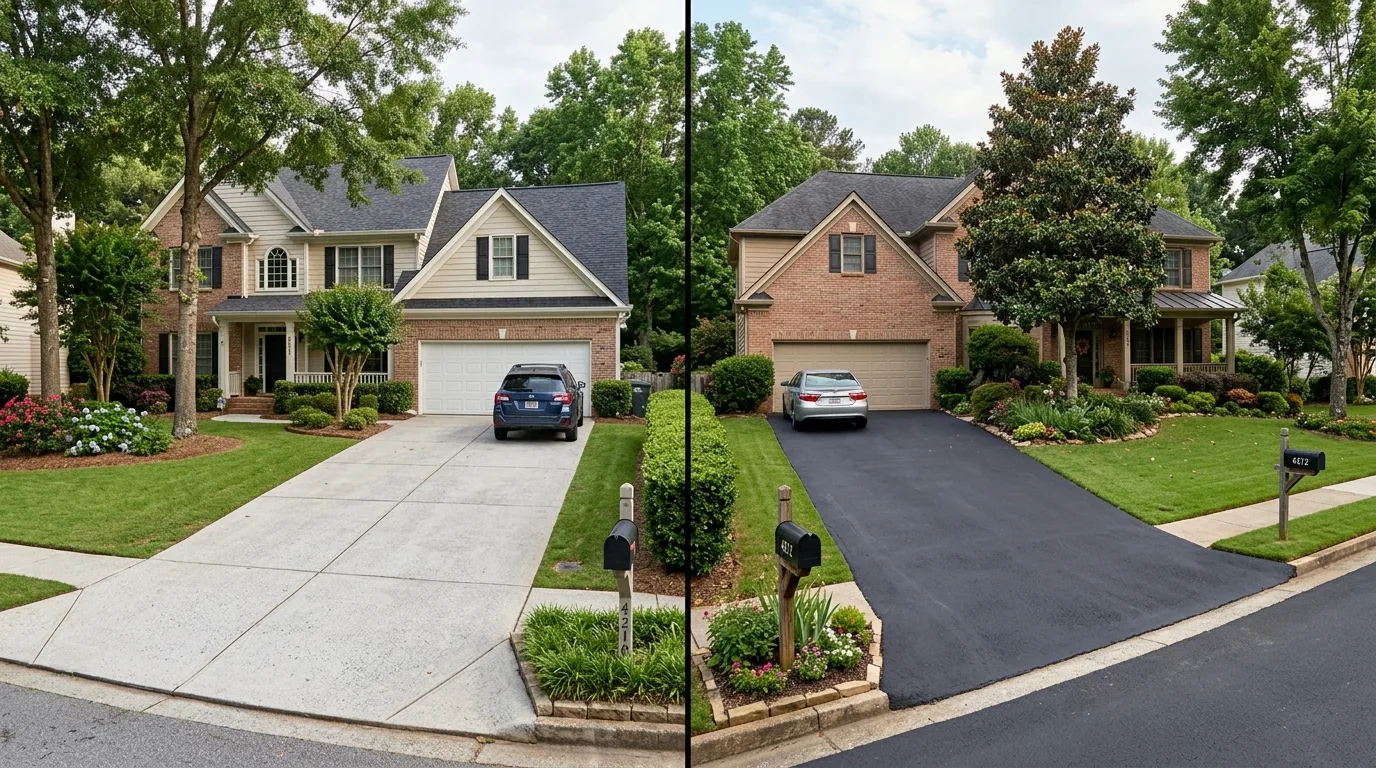
When College Park homeowners are planning a new driveway, the concrete vs. asphalt question comes up constantly. Both materials work. Both have limitations. But in College Park, Georgia’s specific climate — hot summers, expansive red clay soil, and 52 inches of annual rainfall — the two materials perform quite differently over time. In this post, we cover the real differences between concrete and asphalt driveways for College Park properties, with pricing, durability expectations, and a clear recommendation for most situations.
Comparing Concrete and Asphalt in College Park?
We install concrete driveways built for Georgia red clay. Call (888) 376-0955 for a free estimate.
Why This Decision Matters More in Georgia Than Elsewhere
Driveway material selection is more consequential in College Park than in, say, a northern market where freeze-thaw cycles dominate. Here, the primary challenges are different: Georgia red clay soil movement, UV exposure and surface heat, and a 52-inch annual rainfall that cycles the soil beneath the driveway through expansion and contraction constantly. How each material responds to these conditions determines long-term durability and total cost of ownership.
Concrete Driveways in College Park
Cost: $6–$12 per square foot for plain concrete, $10–$18 for stamped. A standard 500-square-foot two-car driveway runs $3,000–$6,000 for plain concrete.
Lifespan: 30–50 years with proper installation and standard maintenance. The key variable in College Park is base preparation — concrete on a properly compacted aggregate base handles the clay soil movement beneath it. Concrete on bare red clay without a base fails much sooner.
Heat performance: Concrete reflects heat rather than absorbing it. In College Park’s 90°F summer conditions, a concrete driveway surface is significantly cooler underfoot than asphalt — a meaningful comfort difference for homeowners with children or pets.
Maintenance: Concrete requires sealing every 3–5 years and occasional crack repair. College Park’s UV exposure and heat cycling make sealing important for maintaining surface integrity and appearance.
Appearance: Concrete allows for the full range of decorative options — stamped patterns, exposed aggregate, broom finish — and maintains its appearance with less maintenance than asphalt over time. For homes in the Historic College Park District, concrete’s decorative flexibility is a meaningful advantage.
Asphalt Driveways in College Park
Cost: $3–$7 per square foot for asphalt installation. A 500-square-foot driveway runs $1,500–$3,500 — roughly half the cost of concrete upfront.
Lifespan: 15–25 years in College Park with proper maintenance. Asphalt requires seal coating every 2–3 years and crack repair as needed to prevent water infiltration. Without maintenance, expect significant deterioration by year 10–12 in Georgia’s UV and heat environment.
Heat performance: Asphalt absorbs and retains heat. In College Park’s summer conditions, asphalt surface temperatures routinely reach 140–160°F on hot days — significantly hotter than the ambient air. This affects comfort for barefoot use and can soften the surface enough to show marks from high heels, kickstands, or RV stabilizer jacks.
Maintenance: More intensive than concrete. Sealcoating every 2–3 years is necessary to prevent oxidation and UV damage that cause asphalt to become brittle and crack. Crack filling is also more frequent. Over the driveway’s life, annual maintenance costs partially offset the lower installation price.
Appearance: Asphalt has a uniform black appearance that some homeowners prefer for its simplicity. It darkens when sealed and fades to gray as it oxidizes between seal coats. Decorative options are limited compared to concrete.
Which Is Better for College Park Homeowners?
For most College Park homeowners, concrete is the better long-term choice for three reasons specific to this market:
Heat: College Park’s 87–90°F summer temperatures make concrete’s heat-reflective properties a genuine quality-of-life advantage over asphalt, which can become uncomfortably hot and soft.
Soil: Georgia red clay’s expansive behavior is challenging for both materials, but concrete on a proper aggregate base handles it better than asphalt, which can rut and deform under the lateral and upward pressure that saturated clay applies.
Total cost: Concrete’s higher installation cost is partially offset by lower maintenance requirements and a significantly longer service life. Over 30 years, the total cost of ownership for a properly installed concrete driveway in College Park is often lower than the cost of asphalt installation plus 30 years of seal coating and more frequent repairs.
Asphalt makes sense if budget is the primary constraint and you’re comfortable with more intensive maintenance — or if you’re planning to sell the property within 10 years and want a lower upfront investment.
Ready for a Concrete Driveway in College Park?
We build concrete driveways built for Georgia red clay — free estimate, itemized quote. Call (888) 376-0955.
Practical Uses for Each Material
- Long-term primary residence: Concrete is almost always the better choice for homeowners planning to stay in their College Park home for 15+ years. The lower maintenance burden and longer service life deliver clear value over time.
- Rental or investment property: Asphalt’s lower installation cost makes it attractive for investment properties where the lower maintenance burden of concrete is less important and the cost is the primary driver.
- Historic district properties: The Historic College Park District’s architectural character is better served by concrete’s decorative options — especially stamped or exposed aggregate finishes — than by asphalt’s uniform appearance.
- Properties near Hartsfield-Jackson: Commercial and industrial properties in the airport corridor typically require commercial-grade concrete for the load requirements of truck and fleet traffic. Asphalt is less suitable for heavy commercial applications.
- Budget-constrained homeowners: If the upfront cost difference is the deciding factor, asphalt is a legitimate choice — just commit to regular seal coating to protect the investment. At year 15–20, a full asphalt replacement plus historical maintenance costs will typically exceed the original cost of a concrete driveway.
Cost Comparison Over 30 Years
For a 500-square-foot two-car driveway in College Park:
Concrete: $3,500–$6,000 installation + $200–$400 per sealing cycle (every 5 years = 6 cycles) = $4,700–$8,400 total over 30 years. May not need replacement within this period.
Asphalt: $1,500–$3,500 installation + $200–$400 per seal coat (every 3 years = 10 cycles) = $3,500–$7,500 plus likely full replacement at year 15–20 ($1,500–$3,500) = $5,000–$11,000 total over 30 years.
The 30-year cost ranges overlap significantly, which is why the maintenance burden and heat performance differences often determine the choice for College Park homeowners who are thinking long-term.
Frequently Asked Questions
Is concrete or asphalt better for College Park, GA?
For most College Park homeowners, concrete is the better long-term choice. Georgia’s summer heat (87–90°F) makes concrete’s heat-reflective surface significantly more comfortable than asphalt, which can reach 140°F+ on hot days. Concrete also handles Georgia red clay soil movement better over time and has a 30–50 year service life vs. 15–25 years for asphalt. The higher installation cost ($6–$12 vs. $3–$7 per square foot) is offset by lower maintenance and longer life. See our concrete driveway installation page for full details.
Does asphalt or concrete handle Georgia red clay soil better?
Concrete on a proper aggregate base handles Georgia red clay better than asphalt. Asphalt is a flexible material that can rut and deform under lateral pressure from saturated clay. Concrete is a rigid material that, when properly reinforced and supported by a compacted base, resists the movement that clay soil imposes. Both materials require proper base preparation on College Park’s expansive clay soil — but concrete’s rigidity is an advantage when that preparation is correct.
How long does concrete last compared to asphalt in College Park?
A properly installed concrete driveway in College Park lasts 30–50 years. Asphalt typically lasts 15–25 years with regular maintenance. The concrete advantage in lifespan is largely attributable to its resistance to UV oxidation and heat softening — both of which are significant factors in College Park’s climate. See our concrete driveway cost guide for a detailed 30-year cost comparison.
College Park Concrete — Built to Last 30 Years
Call (888) 376-0955 for a free concrete driveway estimate. Proper Georgia clay prep and reinforcement on every project.
Related: